Stargazing in Idaho: Dark Skies and Where to Find Them
There is a particular kind of silence that comes with a truly dark sky. You step outside, look up, and the Milky Way is not a smudge or a suggestion -- it is a river of light arching from horizon to horizon, dense with stars you have never seen before. Your eyes adjust. More stars appear. Then more. The sky has depth you did not know was possible.
Idaho is one of the best places in the contiguous United States to experience this. Large stretches of the state are among the darkest in the lower 48, with vast wilderness areas, low population density, and mountain terrain that blocks the glow of distant cities. If you have never seen a truly dark sky, Idaho is where to fix that.
Why Idaho's Skies Are So Dark
The numbers tell the story. Idaho has about 2 million people spread across 84,000 square miles -- that is roughly 21 people per square mile, compared to a national average of about 94. More importantly, a huge percentage of the state is public land: national forests, wilderness areas, and Bureau of Land Management holdings that will never be developed.
The result is that once you leave Idaho's handful of small cities, light pollution drops off dramatically. The International Dark-Sky Association has recognized this, and several Idaho locations have earned official dark sky designations. But you do not need an official designation to find spectacular stargazing. You just need to get away from town and look up.
Idaho's Best Stargazing Regions
Central Idaho Dark Sky Reserve
The crown jewel. In 2017, the area surrounding the towns of Stanley and Ketchum was designated the Central Idaho Dark Sky Reserve, one of only a handful of such reserves in the world. Covering nearly 1,400 square miles, it includes some of the darkest measured skies in North America.
The Frank Church-River of No Return Wilderness, which forms the core of the reserve, is the largest contiguous wilderness area in the lower 48. There are no roads, no power lines, and no artificial light for miles in every direction. The Sawtooth Mountains near Stanley provide a dramatic foreground for night sky photography, with jagged peaks silhouetted against the stars.
Best for: Dedicated stargazers and astrophotographers willing to make the trip to central Idaho. Stanley is about 60 miles north of Sun Valley on Highway 75.
Craters of the Moon National Monument
Located on the Snake River Plain in south-central Idaho, Craters of the Moon is a vast lava field that looks otherworldly even in daylight. At night, the flat, open landscape and distance from any significant town create excellent viewing conditions.
The National Park Service hosts occasional ranger-led night sky programs here during the summer months. The stark volcanic terrain against a star-filled sky is unlike anything else in the state.
Best for: Visitors to southern Idaho, families interested in combining geology with astronomy, and anyone who wants a surreal landscape under the stars.
Bruneau Dunes State Park
Bruneau Dunes, south of Boise in the Owyhee Desert, is home to the tallest single-structured sand dune in North America. It also houses a public observatory with telescopes available for public viewing on select evenings.
The park's desert location and distance from Boise (about 60 miles southeast) keep light pollution low. Observatory programs run on select Friday and Saturday evenings from spring through fall. Even without the observatory, the dunes make a striking foreground for night sky viewing.
Best for: Families, beginners, and anyone near Boise who wants a dedicated astronomy experience with telescope access.
City of Rocks National Reserve
Near the Utah border in south-central Idaho, City of Rocks is a landscape of enormous granite formations that look like a city of stone towers. The reserve sits at about 6,000 feet of elevation in a sparsely populated area, and the dark skies here are outstanding.
Rock climbers know this place well, but it is underrated as a stargazing destination. The granite spires create dramatic compositions against the night sky, and the reserve's campgrounds put you right in the middle of it.
Best for: Rock climbers and hikers who want to extend their day into the night, and astrophotographers looking for unique foreground elements.
The Idaho Panhandle
Northern Idaho does not have the extreme darkness of the central wilderness, but it offers something different: accessible dark skies paired with lakeside camping that makes for a complete experience.
The panhandle's population is concentrated in a few small cities along the I-90 corridor. Once you move south of the interstate -- into the lake country around Harrison, the St. Joe River valley, and the surrounding national forest lands -- light pollution drops significantly.
Stargazing at Harrison Bluffs
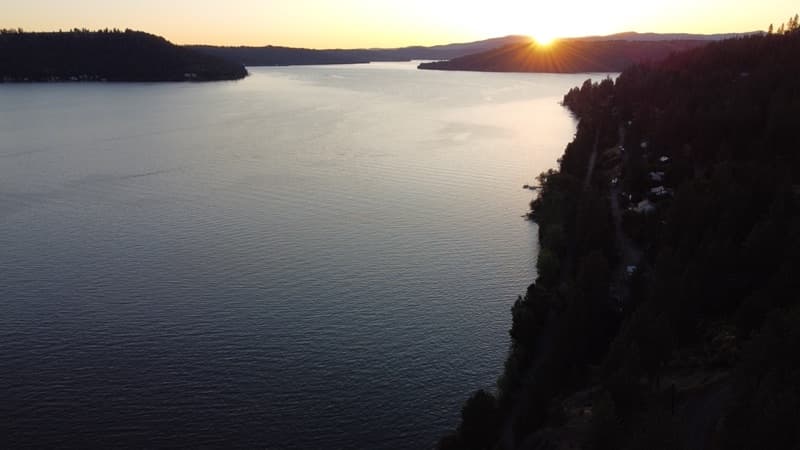
This is where we can speak from direct experience. Harrison, Idaho sits on the southern end of Lake Coeur d'Alene, well away from the glow of Coeur d'Alene city to the north. The bluffs where our campground is located sit at an elevation above the lake, with open sky in multiple directions and minimal ambient light.
Site #3 -- Hike n' Bike is our best stargazing site. It is an open, spacious site with expansive sky views in every direction. Unlike our more sheltered, tree-covered sites, Hike n' Bike gives you a wide dome of sky overhead, and its elevated position means you are looking over the treetops rather than through them. The site accommodates up to 2 guests with one tent and one vehicle, making it a perfect intimate stargazing retreat. At just $20/night, it is also our most budget-friendly option.
On a clear, moonless night at Harrison Bluffs, you can expect to see:
- The Milky Way clearly visible as a band across the sky from late spring through early fall
- Thousands of stars to the naked eye -- far more than you would see from any city or suburb
- Planets like Jupiter and Saturn when they are in favorable positions
- Meteors regularly, with major showers (Perseids in August, Orionids in October) putting on real shows
- Satellites crossing the sky, including occasional bright passes of the International Space Station
The best stargazing months at Harrison Bluffs run from late May through October, which conveniently aligns with our open season. July and August offer the warmest evening temperatures for comfortable viewing, and the Perseid meteor shower in mid-August is a highlight every year.
Tips for Better Stargazing
Whether you are at Harrison Bluffs or anywhere else in Idaho, these practices will improve your experience:
Give Your Eyes Time
It takes about 20-30 minutes for your eyes to fully adapt to darkness. This means no phone screens, no flashlights (or only red-filtered ones), and no trips back to a lit vehicle. Settle into your spot and be patient. The sky will keep revealing more as your eyes adjust.
Check the Moon Phase
The moon is the single biggest factor in how many stars you can see. A full moon washes out all but the brightest stars. Plan your stargazing nights around the new moon or during a crescent phase for the darkest skies. Moon phase calendars are easy to find online and in most weather apps.
Bring the Right Gear
You do not need a telescope to enjoy the night sky, but a few items help:
- A red-light headlamp to navigate without ruining your night vision
- A reclining camp chair or blanket so you can look up comfortably (neck strain is real)
- Warm layers -- even in July, Idaho nights can be cool, and sitting still makes you colder
- A star chart or astronomy app like Stellarium, Sky Guide, or Star Walk (download it before you arrive in case cell service is limited)
- Binoculars -- even a basic pair reveals star clusters, the Andromeda Galaxy, and details on the moon that are invisible to the naked eye
Know What to Look For
If you are new to stargazing, start with the easy landmarks:
- The Big Dipper and Polaris (the North Star) -- your orientation points
- The Milky Way -- look for the brightest band of light, typically visible to the south in summer
- Planets -- they look like bright, steady stars that do not twinkle. Jupiter and Saturn are often visible in summer and fall evenings.
- The Andromeda Galaxy -- visible to the naked eye as a faint smudge in dark skies, it is the most distant object you can see without a telescope, about 2.5 million light-years away
Use an App Sparingly
Astronomy apps are wonderful for identification, but keep your screen brightness at minimum and use a red filter if your app supports it. Even a brief flash of white screen light will reset your dark adaptation by several minutes.
Making a Night of It
One of the best ways to experience Idaho's dark skies is to combine stargazing with a camping trip. Build a fire, let it burn down to embers, and then settle back in your chair as the sky opens up overhead. There is no rush. The stars will be there all night.
At Harrison Bluffs, this is easy to do. Most of our sites have fire rings for evening campfires, and the transition from firelight to starlight is one of the simplest, best pleasures of camping here. Site #3 Hike n' Bike, with its open sky and elevated position, is purpose-built for this kind of evening (note: this site does not have a fire ring, so bring a camp lantern instead), but every site at the campground offers views of the night sky that will stop you mid-conversation.
If dark skies are part of what you are looking for on your next trip, Idaho delivers in ways that few other states can match. And you do not need to trek deep into a wilderness area to find them. Sometimes you just need a bluff, a clear night, and the good sense to look up.
Related Articles
May 15, 2025
Things to Do in Harrison, Idaho: A Complete Trip Planning Guide
From world-class biking trails to lakeside fishing, here's everything you need to know about things to do in and around Harrison, Idaho.
Aug 10, 2024
Exploring the Trail of the Coeur d'Alenes
Your guide to one of America's most scenic paved trails, accessible right from Harrison Bluffs.
May 6, 2026
We're Temporarily Closed: A Note from Harrison Bluffs
Harrison Bluffs is temporarily closed while we work through an issue with the city. We don't yet have a reopening date. Here's what we know, and how you can help.